Spacetime, Relativity, and Quantum Physics

Summaries of the Spacetime Continuum, Einstein's Relativity, and Quantum Theories for beginning and advanced visitors, with Links to the Best Websites on Space, Time, Relativity, Quantum Theory, Quantum Gravity, Higg's Boson, Dark Matter and Energy, plus a discussion of the possibility that we live in an essentially atemporal universe.

We present the general concept of Space and Time, usually called Spacetime or the Spacetime Continuum, and provide links to the main internet sources for exploring Space-Time, Relativity, and Quantum Physics. The Links are the most valuable feature of this website, including a link to the NOVA series Fabric of the Cosmos. Most of the linked sites are maintained by physics departments and professors at major universities, and will help you understand popular current theories. We then discuss some of the problems with these theories, which will eventually lead us to alternate interpretations.

NASA Gravity Probe

Perhaps readers who are not familiar with the current impossibility of reconciling relativity and quantum theory, may be visiting this site expecting to find an answer to the question "what is Space-Time?". Alas, there is no answer, at least not for now, and maybe never. At the University of Michigan's Strings 2000 seminar the participants proposed a list of the ten most important unsolved problems in fundamental physics. Number 5 was - "Why does the universe appear to have one time and three space dimensions?" In other words, what are space and time, and what is the strange combination of space and time that is called the Spacetime Continuum? Spacetime continues to be one of the great scientific mysteries of the universe.

There is another underlying question we have never answered, it is best illustrated by asking - if we travel to the end of the universe and find a brick wall, what is behind the wall? Is our universe inside a walled "container" that might allow us to measure distances from points on the fixed surface of the container? Or is our universe the container itself with nothing beyond the boundaries? If so there is no fixed background we can use to measure time and space. General relativity favors a background free universe where distance and time are measured by relative positions of objects in our universe, so that in a real sense what time it is depends on which object we are standing on when we look at our watch. Quantum Theory favors (but does not necessarily require) the existence of a complex, yet still fundamental, time.

Another one of the ten questions was, "Are all the (measurable) dimensionless parameters that characterize the physical universe calculable in principle or are some merely determined by historical or quantum mechanical accident and incalculable?" What they were really asking is what is the fundamental nature and origin of all the numbers that describe our universe, like the value of pi in the radius of a circle, including space-time? It is clear that human beings cannot go beyond what science calls boundary conditions, yet it may also be impossible for us to answer questions about the most fundamental physical nature of our observable universe.

NOVA - The Fabric of the Cosmos PBS © 2011 WGBH

Before we present our Summary of Space and Time you really do need to watch the PBS Nova series, The Fabric of the Cosmos. It is the best source for learning about current concepts of Space and Time. You can download podcasts (Apple iTunes store has 4 HD podcasts, $1.99 each) or watch the series in DVD and other formats by clicking this link -

The Fabric of the Cosmos. Even though we think that the future will show that Spacetime is far more complex and elegant than even this series suggests, if you want to understand how scientists view Space and Time at the start of the third millennium, you must watch the show.

The Nova link is followed by a list of some of the best Website Links [HR - means Highly Recommended]. If you are just beginning to explore the world of modern physics and cosmology, or if you want to do some advanced research on space-time, special and general relativity, quantum physics, quantum gravity, loop quantum gravity, Albert Einstein, space-time warps, time travel wormholes, or similar topics, you will want to visit the websites. If you want the simplest explanation you may want to read our Brief Summary first. An excellent place for students to start is the University New South Wales award winning website Einstein Light (beginner - intermediate) - click on the Einstein Light box to enjoy "the finer points of relativity in less time than it takes to eat a sandwich" (Scientific American 2005):

Einstein Light

We do not necessarily agree or disagree with what is said on any internet websites, including advertising and other sites linked to below. Some or all, of what we find on internet sites, including some we link to, is completely wrong. Please do your best to thoughtfully analyze and consider everything you read, including advertisements and our opinions on this site. Some sites may be offline for maintenance, if you get an error message try again later. If a web link is broken you should still be able to find the pages referred to by using a search engine.

LINKS TO THE BEST WEBSITES

Spacetime

Spacetime HR WikiPedia entry on Space and Time (beginner)

Spacetime 101 Basic background guide from CalTech (beginner)

SpaceTime HR A simple explanation of SpaceTime (beginner - intermediate)

Warped SpaceTime An overview of warped SpaceTime (beginner)

SpaceTime Warps A discussion of SpaceTime curvature and Time Travel (5 meg PDF file) (intermediate)

Forget Time HR An essay that discusses the very existence of Time (beginner - intermediate)

What Makes Time Special HR An essay on what we may lose if Time does not exist (beginner - intermediate)

Relativity

General Relativity WikiPedia entry (beginner - intermediate)

Special Relativity Nice graphics, fairly straightforward explanations (intermediate)

Reflections of Relativity HR Good explanation of basic concepts (intermediate)

The Light Cone - An Illuminating Introduction to Relativity HR An entertaining graphic view of relativity (beginner)

Relativistic Flight Through Stonehenge Entertaining demonstrations (intermediate)

C-Ship A really cool graphics site (beginner - intermediate)

History of Physics - American Institute of Physics (beginner)

Cambridge Relativity Overviews of many current topics in physics and cosmology (beginner - intermediate)

UseNet Physics FAQ An excellent summary of basic questions in general physics, with bibliography (intermediate)

General Relativity Math Course HR An overview of the math behind General Relativity (intermediate - advanced)

The Meaning of Einstein's Equation A relatively simple introduction to the fundamental geometric nature of the theory of general relativity (intermediate)

Science articles at LANL archive Great source for preprints of science journal articles, highly recommended (advanced)

This Week's Finds in Mathematical Physics Great physics newsletter that offers interesting links (advanced)

Quantum Theory

For detailed information on the Higgs Boson and Quantum Theory visit our new Site QUANTA

Particle Physics Excellent Summary of what we know about Matter & Energy (beginner - intermediate)

Matt Strassler's - Of Particular Significance A comprehensive look at Quantum Theory, worth the effort it takes to find answers on the site (beginner - intermediate)

Quantum Mechanics WikiPedia entry (beginner)

100 Years of the Quantum HR Pre-print of excellent 2001 Scientific American Survey of Quantum Physics (beginner - intermediate)

Measurement in quantum mechanics FAQ Good introduction to issues in Quantum theory (beginner)

What is Quantum Physics? Simple overview of Quantum Physics (beginner)

Where We Stand Excellent overview of current state of Quantum and Relativity Theories - includes some math (beginner - intermediate - advanced)

Quantum Physics Online Flash based Animations of Quantum Physics fundamentals [slow website] (beginner - intermediate)

Visual Quantum Mechanics Shockwave based Animations of Quantum Physics fundamentals [requires free Shockwave player - great interactive "experiments"] (beginner - intermediate)

The Particle Adventure Introduction to particle physics (beginner - intermediate)

Quantum Field Theory

Quantum Field Theory Excellent overview of QFT by Cambridge Prof David Tong (intermediate - advanced) Here is an excerpt from the Introduction:

The concept of wave-particle duality tells us that the properties of electrons and photons are fundamentally very similar. Despite obvious differences in their mass and charge, under the right circumstances both suffer wave-like diffraction and both can pack a particle-like punch.

Yet the appearance of these objects in classical physics is very different. Electrons and other matter particles are postulated to be elementary constituents of Nature. In contrast, light is a derived concept: it arises as a ripple of the electromagnetic field. If photons and particles are truly to be placed on equal footing, how should we reconcile this difference in the quantum world? Should we view the particle as fundamental, with the electromagnetic field arising only in some classical limit from a collection of quantum photons? Or should we instead view the field as fundamental, with the photon appearing only when we correctly treat the field in a manner consistent with quantum theory? And, if this latter view is correct, should we also introduce an “electron field”, whose ripples give rise to particles with mass and charge? But why then didn’t Faraday, Maxwell and other classical physicists find it useful to introduce the concept of matter fields, analogous to the electromagnetic field?

The purpose of this course is to answer these questions. We shall see that the second viewpoint above is the most useful: the field is primary and particles are derived concepts, appearing only after quantization. We will show how photons arise from the quantization of the electromagnetic field and how massive, charged particles such as electrons arise from the quantization of matter fields. We will learn that in order to describe the fundamental laws of Nature, we must not only introduce electron fields, but also quark fields, neutrino fields, gluon fields, W and Z-boson fields, Higgs fields and a whole slew of others. There is a field associated to each type of fundamental particle that appears in Nature.

Quantum Field Theory - Stanford Encyclopedia of Philosophy Another excellent overview for those interested in a basic understanding of QFT (beginner- intermediate)

The Universe is a Strange Place A look at some of the amazing implications of Quantum Physics (beginner- intermediate)

Quantum Field Theory Another easy to understand overview of Quantum Physics (intermediate)

A Long View of Particle Physics How QFT may explain Matter (intermediate)

Quantum Gravity

Quantum Cosmology a pre-print chapter from Beyond the Big Bang, edited by R. Vaas (Springer, Berlin, 2008) (intermediate - advanced) Here is an excerpt from the chapter:

Quantum cosmology is the application of quantum theory to the universe as a whole. At first glance, this may be a purely academic enterprise, since quantum theory is usually considered to be of relevance only in the microscopic regime. And what is more far remote from this regime than the whole universe? This argument is, however, misleading. In fact, quantum theory itself argues that the universe must be described in quantum terms. The reason is that every quantum system except the most microscopic ones are unavoidably and irreversibly coupled to their natural environment, that is, to a large number of degrees of freedom coupling to the system; an example would be a small dust grain in interaction with air molecules or photons. There exists then only one quantum state which entangles system and environment. The environment is itself coupled to its environment, and so on, leading ultimately to the whole universe as the only closed quantum system in the strict sense. It is entanglement with macroscopic degrees of freedom that also leads to the classical appearance of macroscopic bodies, a process known as decoherence. Decoherence is well understood theoretically and has been successfully tested in a variety of experiments. The universe as a whole is thus at the same time of quantum nature and of classical appearance in most of its stages. There exist, of course, also situations where the latter does not hold and the quantum nature discloses itself; these are, in fact, the most interesting situations, some of which we shall discuss in the course of this article.

Conceptually, quantum cosmology is therefore not necessarily associated with quantum gravity. However, since gravity is the dominant interaction at large scales, any realistic framework of quantum cosmology must be based on a theory of quantum gravity. Although there is not yet an agreement on which is the correct theory, there exist various approaches such as quantum general relativity and string theory.

Discussion of current state of Quantum Gravity, String and Loop Theory Comprehensive article discussing alternative viewpoints (beginner - intermediate)

Unfinished Revolution HR a nine page, very highly recommended, perspective on the current state of space-time theory, by Carlo Rovelli, author of Quantum Gravity (beginner - intermediate)

Quantum Gravity - Cambridge University Press An excellent, somewhat controversial, book by Rovelli on the current state of Quantum Gravity theories, Loop Quantum Gravity, and the implications for space-time (advanced)

String Theory

String Theory - A very good overview of String Theory. Author Patricia Schwarz enthusiasm and communication skills provide a good introduction to strings (beginner).

String Theory - WikiPedia's explanation of the theory. (beginner - intermediate)

Critical Look at Strings - A 2011 article by Rovelli that discusses the strengths and weaknesses of string theory. (beginner - intermediate)

Possible Alternatives to String Theory

The Trouble With Physics - review - String Theory is by far the most popular theory. There appears to be a common thread to the quest for alternatives to String Theory that focuses on electromagnetism and relativity with a form of gauge theory, quantum electrodynamics, and topological quantum field theory. Only time will tell if an background free atemporal alternative will be found. (beginner)

Loop Quantum Gravity - Rovelli's overview of the first 25 years of LQG. (beginner - intermediate)

General Topics in Science

Expert Systems - Human beings have strengths and weaknesses, Computers have strengths and weaknesses, Expert Systems are designed to maximize the positives of human intuition and the computational power of machines, while minimizing human and computer errors.

IBM's New Chip - After much analysis, we don't believe that it will ever be possible to design logic circuits that exhibit human "free will". However we do believe that chips will get better and better at making "common sense" choices based on massively complex data. Just as random number generators are not truly random, the computer choices will never be truly free.

Philosophy and Religion

Being and Becoming in Modern Physics Excellent article on SpaceTime Metaphysics in the Stanford Encyclopedia of Philosophy.

Absolute Being and Relative Becoming Interpretation that harmonizes the atemporal block universe of Relativity with the temporal model of Quantum Physics

Physics Meets Philosophy at the Planck Scale Pre-print of chapter by Carlo Rovelli that outlines his views, which we basically agree with, on Space and Time

Christians in Science A thoughtful exposition of the compatibility of religion and science from professors at the University of Cambridge, England

Center for Theology and the Natural Sciences One of several relevant sites affiliated with universities

We do not necessarily agree or disagree with what is said on any internet websites, including advertising and other sites linked to above. Please do your best to thoughtfully analyze and consider everything you read.

SpaceTime is Sponsored by our philosophy and religion site LifeNotes. Please visit our site:

LifeNotes

A Brief Summary of SpaceTime:

Einstein’s theories of relativity tell us that Space, for example - the room you are sitting in, and Time, the minutes that tick away on your watch, are all part of a single physical entity, the SpaceTime Continuum. SpaceTime has four dimensions, roughly corresponding to east-west, north-south, up-down, and past-future. We can drive from east to west, north to south, and go up and down mountains. While we are driving in any direction we are always driving from our past to our future – that is basically why space and time are linked, we can’t move through space without moving through time!

Before Einstein, Isaac Newton shared the popular belief that both absolute time and absolute space exist. Newton believed that the grid that defined absolute space was undetectable, but that there is a universal time that ticks away for all observers in all locations, and that universal time can be accurately measured by clocks. If it is 5 o'clock on planet earth, it is simultaneously 5 o'clock on the most distant star. Similarly, Newton believed that absolute space exists that can be measured using the same yardstick (meter-stick) anywhere in the cosmos, a mile measures the same distance anywhere on Earth and on any distant star as it does where you are standing right now.

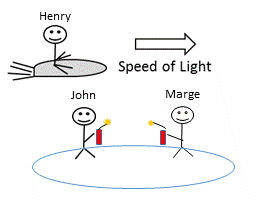
There are lots of problems with this idea, experimental observations simply do not support the conclusion that absolute time and absolute space exist. In 1905 Einstein published his theory of special relativity, which introduced the then radical idea that different observers see the same event occurring at different times and places. For example, Bill and Sally may see two firecrackers that they ignite explode at exactly the same time, while Jane (in motion at a distance) may see one of the two firecrackers explode a few seconds before the other one.

Einstein used the concept of relationships between frames of reference to explain how these "crazy" observations are real and actually do occur. Frames of reference may be thought of as invisible "coordinate map grids", like the letters and numbers on the sides of roadmaps, attached to every observer so that the observer can measure the position of surrounding objects.

Special relativity tells us that observers who are in a state of uniform motion with respect to one another are in "inertial frames of reference", and that they cannot use the laws of physics to distinguish the frame of reference of one observer from the frame of reference of any other observer. In an inertial frame of reference, there is no physical experiment whatsoever that you can perform that can distinguish between a state of rest and a state of constant velocity (if you are in an elevator, when it starts moving downward a ball released from your hand does not fly to the ceiling). If you are in a windowless room, there is no experiment that you can perform in that room that will tell you if the room is stationary, or is moving in some direction at a constant velocity, or is in uniform "free fall" acceleration.

Think about being in a silent electric car with all the windows painted black (you can’t see out so you can't tell if you are moving relative to the road and you can’t listen to the engine for clues about your speed). If the car is standing at a red light, and you put a coffee cup on the dashboard, the cup will not move. If the car is going a steady 120 miles an hour (you did not feel the acceleration because you were asleep), and you put the cup on the dashboard, the coffee will not fly back and hit you in the face. There is no experiment that you can do inside the car (which is your inertial frame of reference) that will tell you if you are standing at a red light, or going down the road at 90 miles per hour, or even 90,000 miles per hour! What happens when a car accelerates smoothly after the red light turns green? The same thing that would happen if the car fell (smoothly) off the edge of a cliff, as the car falls toward the ground below the coffee will still remain in the cup on the dashboard (until you reach the valley floor).

Note that Newton's first law of motion, which in essence states that an object in motion will remain in motion unless acted on by an external force, is consistent with this result at lower speeds. So long as Newton's laws are applied only where relative velocities do not approach the speed of light, Newton's laws of motion give us "close enough" results, even in a relativistic universe. That is why they are still taught in schools as "true" physical laws.

You cannot determine if the car is moving at constant velocity, or is standing still, or is in a uniformly accelerating gravitational free fall. That does not mean that you cannot determine non-uniform acceleration. If you press the accelerator so that the car "speeds up", or if you swerve from a straight path, you will feel the acceleration and be able to measure it (the coffee cup will fly off the dashboard). None-the-less, there is no physical experiment whatsoever that can distinguish between a state of rest, a state of constant velocity, and a state of gravitational free fall. Our solar system is located on a spiral arm of the Milky Way galaxy, which rotates at a constant velocity (creating a nearly inertial frame). If we did not live in inertial frames, and we could do an experiment to measure the motion, then every time we got out of bed the speed of our earth / solar system rotating around the Milky Way (about 155 miles/sec or 250 km/sec) would knock us to the floor! Every time we set the coffee cup down in our moving car, the coffee would hit us in the face!

One startling conclusion that we reach from all this is that the velocity of light must have the same value for all inertial observers, even if they are moving toward or away from the source of the light. If this was not true, an observer could perform an experiment using a beam of light to measure the velocity of their inertial reference frame, and then use that result to determine which of several frames of reference (frames in constant motion) they were actually in. The disastrous results of a speed of light that is additive (not constant in all frames) would include being hit in the face by the coffee, and, even worse, being plastered to the floor by the speed of the earth flying through space.

Experimental results fully support the counterintuitive predictions of special relativity. Clearly, the idea that the speed of light is constant is inconsistent with an absolute space that is distinct and separate from an absolute time. Modern physics replaces Newtonian space and time with a single entity, space-time. Minkowski, who along with Einstein formalized the math of Spacetime, said, "…henceforth, space by itself, and time by itself, have vanished into the merest shadows and only a kind of blend of the two exists in its own right."

Space-time is essentially a "curved" geometric construct that allows for the relativity of simultaneity. In other words, if one observer correctly concludes that two events occur simultaneously, the same events would appear to take place at different times to an observer who was in motion relative to the first observer. Both the observer who measures the two events to be taking place simultaneously, and the observer who measures the events as taking place at different times, are right! Our example above is correct, one observer will see a firecracker they light and a second firecracker that a friend lights explode at exactly the same time, while a third observer moving relative to the other two will see one firecracker explode before the other firecracker. Relativity tells us that both are right!

Both time and space are relative, and are "different" for observers in relative motion to one another. For one observer the two firecrackers actually did explode at precisely the same time, while for the other observer one firecracker exploded a few seconds before the other. The time and distance measured by each observer is different, both are right, neither is wrong!

Relativity tells us that time and distance change depending on the relative motion of the observers. If Observer A measures the passage of one hour on their clock, another observer B who is in relative motion to observer A may measure the passage of 30 minutes on the clock. If Observer A measures a distance of one mile on their ruler, another observer B who is in relative motion to observer A may measure a distance of 1/2 mile on the ruler. We don't see time or distance shrinking on earth because the effect is virtually undetectable until the relative motion of the two observers approaches the speed of light (299,792,458 meters per second). None-the-less, the time and distance measured by two observers in relative motion to each other is different, only the speed of light measured by all observers is the same. Einstein-Minkowski space-time is made up of three spatial dimensions x, y, and z, and one time dimension t. Space-time is commonly thought to be the history of the entire universe, containing every "event" that ever happens. A "world-line" is the history of an object in "space-time".

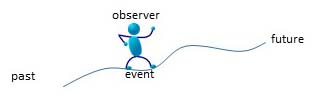
Special relativity allows us to define a distance from the origin for all the points on a world-line, allowing the world-line to be a set of points that have physically distinguishable properties. Therefore, we can identify each of the events on a world-line as distinct points in space-time. Each point on the world-line is a particular event that happens at one place in space (represented by the values of the x, y, z coordinates) at one particular time (represented by the value of the t coordinate) - i.e. one place in space-time. Each point on the world-line of a human being is generally thought to be a real physical event that represents a unique sequential moment in the life of that individual, from birth to death.
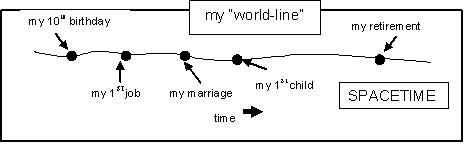
World-Line

Einstein said “Imagination is more important than knowledge”. So to better understand what we are talking about set your imagination free and take a journey with me into space-time. Imagine a universe that is totally empty except for one single ball. There is absolutely nothing else in the entire universe, no atoms, no rocks, no people, just a single ball we will call ball “A”. The ball is floating in totally empty space, there is no background behind it, no horizon, nothing. How far is the ball from anything else in this one object universe? There is no answer, because the ball is the only object in the universe, so there is absolutely nothing else in the universe that we can measure a distance to, not even some kind of background like a sky full of stars (we ignore rotation and frame dragging in our examples - which we think raise difficult questions that have not been satisfactorily answered).

Ball A

Now add a second ball "B" to our universe.

Ball A and Ball B

How far is it from ball A to ball B? We reach for a ruler – but wait – remember that the only two objects in the entire universe are the two balls, there are no other objects, no rulers, not even a background grid to measure against! Just two balls floating in nothing.

Here we can see the problem - since there are only two objects in the entire universe, ball A and ball B, there is no ruler you can go get to measure the distance between ball A and ball B. There is no way whatsoever to measure the distance between A and B because there is nothing to compare the positions of the balls to. So it seems that we must conclude that there is “separation” but there at least appears to be no such thing as "distance" in this two object universe.

Add a third ball "C" to the universe (remember there are three objects A, B, and C in the universe and absolutely nothing else).
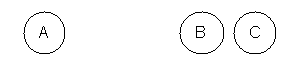
Ball A, Ball B, and Ball C

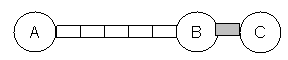
Now if we ask how far it is from A to B we can at least make an imaginary ruler using the distance of B to C:
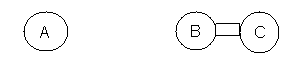
Distance from A to B

and then measure the distance from A to B using our new ruler:

Distance from A to B is equal to 5 B to C units

By comparing the distance from A to B to the distance from B to C – we see that the separation between A and B is five times greater the separation from B to C.

Remember – you are looking at these drawings on a computer screen or on paper. The screen/paper gives us an extra “object” that really does not exist in our one, two, and three ball universes. There is no background in our examples, the balls are simply suspended in empty space. As you read remember, and imagine, that there is no screen, no paper, no background – the balls simply float in absolute nothingness.  

We could have chosen to build our ruler using the distance from A to B instead of B to C:

Distance from A to B used to measure B to C

then the distance from B to C would have been 1/5th the distance from A to B.
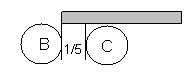
Measuring A to B using B to C

We can ask what the distance is from A to B by comparing it with B to C - and say that it A to B is 5 times the distance from B to C, or we can ask what the distance is from B to C by comparing it with A to B - and say that B to C is 1/5th the distance from A to B.  

What we have done is to choose A to B or B to C to be our "ruler". That is what we human beings do when we build a "meter" (or a "yard") stick, we define the distance from end of a wooden stick (A) to the other end (B) to be one meter (yard) so we can use it to measure the distance between any other points in the world.

A to B to C

Because we are using endpoints A and B that we arbitrarily chose to define a meter (yard), we are comparing the distance from endpoint A to endpoint B and endpoint B to endpoint C, just like we did with the three balls in the three object universe.  

Now crank up your imagination a couple notches. What if the balls looked like this in Universe X -

A to B to C

instead of like this in Universe Y:  

A to B to C

Wait a minute – we said there is no paper in our three ball universes, no backgrounds to measure against. So if we measure A to B using B to C we get the very same answer in both universes – the “distance” from A to B is Five times the “distance” from B to C. Since the balls are floating in absolutely empty space, there is no background, no horizon, no grid, we can use to measure an absolute distance between A and B and B and C. There is no way to tell if we are in Universe X or Universe Y. If we see three balls and measure the distance from A to B to be 5 time the distance from B to C:

A to B to C

Are we in Universe X or Y? We absolutely cannot tell. In Universe X we measure the distance from A to B to be 5 time the distance from B to C, and in Universe Y we measure the distance from A to B to be 5 time the distance from B to C – there is nothing we can measure that will tell us which Universe we are in (Quantum theory adds a lot of questions we won't deal with here).


What all this tells us is that what matters is the relative position of objects in the universe, not the absolute position, because there is no absolute position. We measure the relative position of objects and that allows us to measure the relative distance between two objects. That is what relativity is all about, there is no absolute distance because there is no background, no “piece of paper”, to measure absolute distances against.

Everything would be pretty simple if relative positions never changed:

A B C

but they do change, constantly, because objects are in “motion” and “motion” means change in relative position:

A and B and C changing relative position

Use your intuition to realize that for every change in the relative position of A and B there is a physical limit on the change in relative positions of A, B, and C – in other words there is a physical limit on the speed in which objects can move away from each other. It is a tiny bit like the fact that when you get in your car to go to the grocery and step the accelerator to the floor, there is a physical limit on the change in how far you are from your house and how close you are to the store. No matter how hard you press the accelerator the speedometer will never reach 500 miles per hour, and it will always take you a minimum length of time to get from your house to the store.

In the universe in which we live there is a physical limit on the change in relative position of all objects, including balls A and B and C, it is called the “speed of light”. Light can be thought of as being little balls of energy called photons (I know we are oversimplifying and the descriptions are really not right – but they illustrate our points). Assume ball C is a photon “ball”. Because of physical limits on the change in relative positions, i.e. on the speed the three balls can separate from each other, ball A and ball B can never move apart (change relative position) so that the change in relative position between ball A and ball B is greater than the change in relative position between ball A and photon C or ball B and photon C. A and B can never speed apart from each other so that they go faster than a photon speeding away from A and B. The speed of light is a physical limit on the motion of every object that is part of our universe, period.

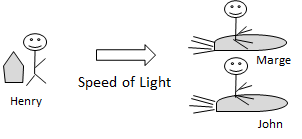
Now here is where it gets weird, or weirder. Instead of three balls in an empty universe, let’s look at John, his brother Henry, and their friend Marge. John is having his morning cup of coffee with Marge at the local café at 500 Main Street. His brother Henry is back at the house where both live at 100 Main Street. John and Marge leave the café and get on their “Speed-o-Lite” rocket motorcycles. Both start driving off away from Henry at almost the speed of light. So far no problem:

Henry, John, and Marge

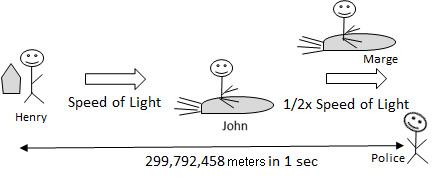
Relative to Henry, John and Marge are speeding off (changing relative position) at almost the speed of light – but John and Marge are driving beside each other so they are not moving apart at all. Marge wants to try out her bike, so she pushes the accelerator and shoots ahead of John – going away from John at what is almost ½ the speed of light – wow!!!!!
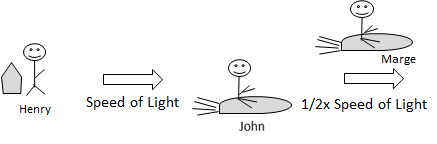
Henry, John, and Marge

So John is moving away from Henry at almost the speed of light, and Marge is moving away from John at ½ the speed of light, Marge must be moving away from Henry at 1 and ½ times the speed of light – right?

Wait a minute, we said that the physical limit on how fast any two objects can move away from each other is the speed of light – so John is moving away from Henry at almost the speed of light and Marge is moving away from John at ½ the speed of light – yet both are moving away from Henry at a bit less than the speed of light????? I am confused?

This is where space-time takes over. We can think of Space-Time as being like a sheet of rubber cloth on which we draw a map, with every “location” and "time" of every event being a dot on the rubber map. Henry, John, and Marge use a ruler to measure the distance between them on the map to be one mile (and agree that it is 10 am in the morning).

Spacetime map

    Space-Time map - 0 mile           1 mile           2 miles           3 miles

As John and Marge speed off together they leave Henry behind, with the relative positions of Henry and John / Marge changing at close to the speed of light. But when Marge decides to speed off ahead of John something has to change or Marge will be going less than the speed of light relative to John but faster than the speed of light relative to Henry – and that is physically impossible!

Spacetime map

Space-Time map - 0 mile           1 miles  1.25 miles  1.5 miles  2 miles

What happens is that space-time, the rubber map, comes to the rescue. For Henry and John the space-time rubber map stays essentially the same, and John zooms off at just a bit under the speed of light relative to Henry.

Spacetime map

    Space-Time map - 0 mile                          2 miles       

Now the amazing thing - for Henry and Marge the rubber space-time map shrinks, and Marge also zooms off at just a bit under the speed of light relative to Henry. The space-time map shrinks so the ruler she uses to measure how far she is from Henry shrinks, and the clock she uses to determine how fast she covered the distance slows down, relative to Henry. The result is that both she and John are speeding away from Henry at less than the speed of light.

Spacetime map;

    Space-Time map - 0 mile                        2.(5) miles 

Remember that the ruler and clock that Marge uses to measure her distance and speed relative to John shows Marge .5 miles ahead of John moving away from him at ½ the speed of light (space-time between John and Marge does not shrink – at least not much). None-the-less, spacetime and the ruler Marge uses to measure her relative distance from Henry shrinks just enough so that she is not going faster than the speed of light relative to Henry!

Spacetime map

    Space-Time map -                                 0 mile           .5 mile      

This is why distance and time depend on the relative position of objects, not the absolute position, and the change in the relative position of objects. If distance and time did not change depending on the relative positions of objects in motion, those objects could move apart at speeds greater than the speed of light, the physical limit no object can exceed, and the world would be an even weirder place than it is.

Because everything is relative, Einstein proved that the length of our measuring sticks and the time on our clocks vary depending on the speed that the objects we are measuring are moving relative to each other. Once you understand the idea of measurements being relative, the idea of rulers shrinking and clocks going slower is not as strange as it might seem.

The space and the time measured between events in Spacetime is relative, with different distance and time being measured by observers depending on the motion of the observers relative to the events. This is what Space-Time is all about!

Click here to go back to links

Now to our Viewpoint:

Please understand that while they include references to scholarly papers, the ideas themselves represent interpretations of those articles by an amateur, and should not be considered in any way to be accepted viewpoints. If your goal is to understand spacetime as science now believes it to be, then you should limit your reading to the Summary and Links above. If you want to venture into what would now be viewed by most as part science, part pseudo-science, part science fiction, and perhaps all wrong, then read on.

Special relativity is part of general relativity, and is valid only under a limited set of conditions. The theory of general relativity provides strict rules that neither special relativity, nor any of our other theories of the universe, can violate. The problem with space-time is that general relativity tells us that there is no fundamental "metric" that can be constructed on the space-time "manifold", there is just a manifold, or perhaps no manifold at all. A space-time "metric" is a distance function that has properties similar to distance in Euclidean space and that is used for relating a number to every pair of objects in space-time, somewhat like a grid on a map is used to calculate the distance from A to B. A space-time manifold is a topological space equipped with a family of local coordinate systems that are related to each other, containing every event that ever happens.

As we just said, a "world-line" is the history of an observer in "space-time". Space-time is essentially the history of the entire universe, containing every "event" that ever happens. Each point on the world-line is generally thought to be a real physical event at a unique point in space-time. Special relativity allows us to define a distance from the origin for all the points on a world-line, allowing the world-line to be a set of points that have physically distinguishable properties. Therefore, we can identify each of the events on a world-line as distinct points in space-time.

If our universe is in fact fully relativistic, with no fundamental metric, it is quite possible that in general relativity there is no sense in which we can talk about the "length" of a "world-line". It may be that we cannot even say that, given two manifolds, a world-line in one is a world-line in the other "plus an extra bit", simply because two such four dimensional manifolds with two "different" world-lines exhibit diffeomorphism invariance and represent the same physics. This would mean that the two world-lines in the two manifolds could not be distinguished from each other (similar to not being able to tell if our car is at rest or in motion). In other words, a manifold with one shape can undergo a diffeomorphic transformation into a manifold of another shape, and the laws of physics cannot be used to distinguish one from the other - you simply cannot tell which one you are in!

If this is a correct interpretation of general relativity, if we cannot construct a metric on the space-time manifold, it is possible that the points on a world-line cannot be thought of as representing something different from each other. It is quite possible that the only information that a particle's world-line contains is that the "particle exists". If so, there would be nothing about the world-line that describes something that exists in "time", and there would be no temporality of any kind associated with the world-line!

The best way to introduce our viewpoint is to ask the following question, "Assume that every object in the universe stops moving. If every object is frozen in space, does time continue to tick away?" The common sense answer is that it does. The best guess answer from quantum theorists, string theorists, and special relativity advocates is that in some sense it does. Yet the best guess from those who believe that general relativity should be taken literally, is that time stops when relative motion stops.

A few of the physicists who specifically study "space-time" go one step further and assert that general relativity does not tell us that time stops, rather Einstein's field equations tell us that on a fundamental level "time" does not exist at all! They argue persuasively that "time" is not a fundamental part of the universe, rather "time" is a quantity that is derived from the relative motion of objects in the structure we call "space" (which itself may or may not be fundamental). In a frozen universe there is no "time", only "space" (perhaps a different kind of space than we think it is, perhaps no space at all - only relative position). This is what we believe to be true.

The following example illustrates our ideas. Assume that the only objects in the universe are two rows of dominoes, row A and row B. Assume that both rows are frozen in space, no domino is moving relative to any other domino.

Dominoes define time

It is clear that in some sense "space" exists because the two rows are frozen in space. The "space" that the rows occupy appears to be quite real, even if it is just the relative "position" of the dominoes. Yet if in this universe we ask, "What time is it?", we cannot give an answer. There is no clock to measure time by, indeed there is no motion that we can use to define time. There appears to be nothing in the universe except the objects and the space that they occupy. We believe that time simply does not exist in this universe. Therefore space (relative position), and not time, is the fundamental observable quantity in this universe (perhaps even space is not fundamental, we will not address that possibility). Now assume that both rows start falling.

Dominoes count the minutes

It is clear that we can calculate the "time" it takes for row A to fall by comparing it to the "rate" of fall of the dominoes in row B, just like we would do if we compared the falling dominoes to the motion of the second hand on a watch. It is also clear that we can calculate the "time" it takes for row B to fall by comparing it to the rate of fall of the dominoes in row A. For every one domino that falls in row A, two fall in row B. We can choose row A as our clock and, in a sense, row B as our "ruler", and say that for every one unit of time measured by row A the dominoes fall through two units of space measured by row B. Or we can choose row B as our clock and row A as our ruler, and say that for every one unit of time measured by row B the dominoes fall through one-half unit of space measured by row A. After the dominoes start falling we define "time", and that is the point. The "time" that we define is not a fundamental observable in our universe, only "space" (relative position) is. We could not observe "time" until we derived "time" from relative motion within the observable quantity we called "space" (which is different to "distance").

The idea that time does not "exist" as an independent quantity would seem to be quite speculative, except for one very interesting fact. We know that Einstein's theory of special relativity (SR) describes the universe using "time". However, special relativity is not the most fundamental theory, as we said, it is derived from Einstein's theory of general relativity (GR). The tools of special relativity give us less generalized solutions that are correct only under a limited set of circumstances. In general relativity the universe is described by solutions to Einstein's field equations. Most physicists believe that a particular description of the universe is correct only if it is a solution to those field equations. The amazing fact is that Einstein's field equations can be solved without any reference whatsoever to a temporal variable of any kind, indeed the field equations may be solved without even defining "time". This astounding fact greatly increases our confidence that we live in an essentially atemporal world.

A respected physicist named Carlo Rovelli has published what we find to be the best exposition of the lack of "time" in general relativity. A recent summary of his views is found in "Forget Time". In a preprint of a chapter he wrote for the book ,"Physics Meets Philosophy at the Planck Scale", Callender and Hugget eds., Cambridge University Press, Rovelli also summarizes the situation (the download is linked to a PDF file, the preprint is also available in other formats from http://xxx.lanl.gov/abs/gr-qc/9903045.) Rovelli's original work, published in the 1980's, is available as a pdf version of a LaTex file time.tex.pdf (some text was lost in converting the format). The paper goes into more detail about presymplectic mechanics and the Heisenberg view of quantum space-time. Acrobat PDF reader is available at http://www.adobe.com/support/downloads/acrwin.htm.) See also Carlo Rovelli's website.

In his technical explanation of the lack of a fundamental "time", Rovelli says: "In classical GR, a point in the physical phase space, or a state, is a solution of Einstein equations, up to active diffeomorphisms. A state represents a 'history' of space-time. The quantities that can be unequivocally predicted are the ones that are independents from the coordinates, namely that are invariant under diffeomorphisms. These quantities have vanishing Poisson brackets with all the constraints. Given a state, the value of each of these quantities is determined. In quantum gravity, a quantum state represents a 'history' of quantum space-time. The observables are represented by operators that commute with all the quantum constraints. If we know the quantum state of space-time, we can then compute the expectation value of any diffeomorphism invariant quantity, by taking the mean value of the corresponding operator. The observable quantities in quantum gravity are precisely the same as in classical GR."

"Some of these quantities may express the value of certain variables 'when and where' certain other quantities have certain given values... These quantities describe evolution in a way which is fully invariant under the parameter time, unphysical gauge evolution. The corresponding quantum operators are Heisenberg operators. There is no Schrodinger picture, because there is no unitary time evolution. There is no need to expect or to search for unitary time evolution in quantum gravity, because there is no time in which we should have unitary evolution. A prejudice hard to die wants that unitary evolution is required for the consistency of the probabilistic interpretation. This idea is wrong."

"In quantum gravity, I see no reason to expect a fundamental notion of time to play any role. But the nostalgia for time is hard to resist. For technical as well as for emotional reasons, many approaches to quantum gravity go out of their way to reinsert in the theory what GR is teaching us we should abandon: a preferred time. The time 'along which' things happen is a notion which makes sense only for describing a limited regime of reality. This notion is meaningless already in the (gauge invariant) general relativistic classical dynamics of the gravitational field. At the fundamental level, we should, simply, forget time."

The immediate question is how can the state of the universe evolve if there is no time in which it can evolve? How can the dominoes fall if there is no time for the dominoes to fall? The answer is that state evolution can occur even where there is no time. All that is required is some mechanical action like that provided by presymplectic mechanics. Rovelli says: "Mechanics may be defined as the general theory of the evolution of physical systems in time. From this point of view, time is required for the very definition of the elementary mechanical concepts. For instance, the state of the system is defined at a given time. In such a conceptual framework, (t)ime is required. However, there exists an alternative starting point for mechanics. This is provided by presymplectic mechanics. This formulation does not require the absolute time for defining the basic concepts of the theory. We shall illustrate presymplectic mechanics by first showing that Hamiltonian mechanics admits a reformulation in terms of a presymplectic space, and then noticing that this reformulation does not require the variable that represents time to be specified, or even defined. ... In presymplectic mechanics, which is an elegant generalization of standard hamiltonian mechanics, a dynamical system is just defined by a presymplectic manifold......"

After years of reading in this area, our intuitive feeling is that we do in fact live in an essentially atemporal universe, a world without a fundamental "time". However, we do not want to minimize the complexity of the issue. Most string theorists and quantum researchers believe that relativity is wrong, or at least incomplete, and that a fundamental "time" does exist. They take a radically different approach to the search for "quantum gravity" and "quantum space-time". Three excellent articles about the fascinating search for Quantum Gravity are included for your information (each PDF file may take several minutes to download on a dial-up connection): Prima Facie Questions in Quantum Gravity and Strings, loops and others: a critical survey of the present approaches to quantum gravity; plus an article about time and wave function collapse: Can we compute the exact time a quantum measurement happens? Also, here is an article that argues that none of this really matters: A possible solution to the problem of time in quantum cosmology.

Minkowski, who along with Einstein formalized the math of space-time, said, "…henceforth, space by itself, and time by itself, have vanished into the merest shadows and only a kind of blend of the two exists in its own right." The classic text on relativity by Wheeler and Taylor says about space and time "Equal footing, yes; same nature, no. There is a minus sign in this formula that no sleight of hand can ever conjure away. This minus sign marks the difference in character between space and time..." There are many, many physicists who believe that space-time has a radically different nature than we think it does. However, despite the absence of a fundamental "time" in GR, few are willing to conclude that we live in some kind of a "spatial" universe that lacks any form of temporality. Many who agree that the universe lacks a fundamental temporal variable (t), still believe that the universe exhibits fundamental "temporality". They may be right. None-the-less, we strongly believe that we should accept what general relativity is telling us, and that we should look for an essentially spatial (relative position) model of our universe that will accommodate quantum mechanics.

Rovelli notes that: "Conventional field theories are not invariant under a diffeomorphism acting on the dynamical fields. (Every field theory, suitably formulated, is trivially invariant under a diffeomorphism acting on everything.) General relativity, on the contrary, is invariant under such transformations. More precisely, every general relativistic theory has this property. Thus, diffeomorphism invariance is not a feature of just the gravitational field: It is a feature of physics, once the existence of relativistic gravity is taken into account. Thus, one can say that the gravitational field is not particularly ``special'' in this regard, but that diff-invariance is a property of the physical world that can be disregarded only in the approximation in which the dynamics of gravity is neglected. What is this property? What is the physical meaning of diffeomorphism invariance?"

"Diffeomorphism invariance is the technical implementation of a physical idea, due to Einstein. The idea is a deep modification of the pre-general-relativistic (pre-GR) notions of space and time. In pre-GR physics, we assume that physical objects can be localized in space and time with respect to a fixed non-dynamical background structure. Operationally, this background spacetime can be defined by means of physical reference-system objects, but these objects are considered as dynamically decoupled from the physical system that one studies. This conceptual structure fails in a relativistic gravitational regime. In general relativistic physics, the physical objects are localized in space and time only with respect to each other. Therefore if we "displace"' all dynamical objects in spacetime at once, we are not generating a different state, but an equivalent mathematical description of the same physical state. Hence, diffeomorphism invariance"

"Accordingly, a physical state in GR is not 'located' somewhere (unless an appropriate gauge fixing is made). Pictorially, GR is not physics over a stage, it is the dynamical theory of (or including) the stage itself."

The following is VERY speculative, based mostly on intuition and not objective science, is offered for discussion only, and should not be considered in any way as actual theory. If you are interested in the current science of space-time, you can stop reading here.

We will now offer a few suggestions about what an atemporal model might look like, but before doing that we need to answer the question, so what? Why does it matter if time exists as a fundamental observable, or just as a derived quantity? The answer is that lack of a fundamental time may mean that we live in an essentially "spatial" (relative position) universe that may be profoundly different from the currently spatio-temporal model.

The Stanford Encyclopedia of Philosophy describes space-time as follows: "Virtually all modern space-time theories are now built in the same way. The theory posits a manifold of events and then assigns further structures to those events to represent the content of space-time."... "Consider our universe, which relativistic cosmologies attempt to model. Events in the universe correspond to the dimensionless points of familiar spatial geometry. Just as a geometric point is a particular spot in a geometrical space, an event is a particular point in a cosmological space at a particular time." (emphasis added)

If we live in an essentially spatial world, this universal model of space-time is probably wrong. In current temporal theories each point in space-time is associated with one sequential event, and one event only. If we live in an atemporal universe, each point in space-"time" may have multiple events associated with it. This is admittedly very speculative, but it is far too fascinating not to explore. We know from relativistic and quantum field theories that "objects" are in some sense waves that travel through space. If the universe is a four (or other number) dimensional "space", rather than a four dimensional "space-time", then waves may move through some kind of homogeneous "space", not "space-time".

The following diagram is intended to do no more than suggest the truly profound possibilities that an atemporal model may present. We have replaced the axis normally labeled t for time with an arbitrary w axis to reflect the fact that all four dimensions are identical in nature. All directions lead into "space", none into "time". We then arbitrarily suppress any two of the axis, and show the two remaining axis on the graph. We pick a point that is one unit out on the horizontal axis. Each graph represents state evolution due to presymplectic mechanics, visualizing sequential motion through an atemporal 4D space. The important thing to note is that a given point 1 unit out on the horizontal axis, can have associated with it multiple values in the other three dimensions.

atemporal waves

The whole point of this absurdly simplistic graph is to emphasize the possibility that in an atemporal universe every point in space can have multiple values as the wave "passes" through the space occupied by that point. Each value is an "event" at that point, each point represents multiple events. This cannot happen in a temporal model, simply because an event is a particular point in a cosmological space at a particular time. In a temporal universe if we observe a wave at a point in space-time it must have a particular value. In a world without temporality, if we observe a wave at a point in space-time it will have different values depending on the spatial order in which we observe the points.

We hesitate to mention this (it is extremely speculative and is offered to stimulate thought on the matter), but there is an intuitive commonsense feeling that the occurrence of the various possible values at each point in a truly spatial universe looks a lot like quantum probabilities. Indeed, we see that what determines the value that we observe at a given point in a spatial universe is the physical observation itself. In other words, in our simplistic graph above, if we look at the first frame we see a particular value, if we look at the second frame we see another value, if we look at the third frame we see a third value, etc. This "feels" a lot like the Copenhagen interpretation where observation determines the value when the "wave function collapses".

Indeed, there are similarities to the virtually ignored, yet very interesting, "transactional interpretation" of quantum mechanics proposed some ten years ago by the physicist John Cramer, who said: "To summarize the transaction model, the emitter produces a retarded offer wave (OW) which travels to the absorber, causing the absorber to produce an advanced confirmation wave (CW) which travels back down the track of the OW to the emitter. There the amplitude is CW1~|OW2|2, where CW1 is evaluated at the emitter locus and OW2 is evaluated at the absorber locus. The exchange then cyclically repeats until the net exchange of energy and other conserved quantities satisfies the quantum boundary conditions of the system, at which point the transaction is complete. Of course the pseudo-time sequence of the above discussion is only a semantic convenience for describing the onset of the transaction. An observer, as in the simpler plane wave case, would perceive only the completed transaction which he could reinterpret at the passage of a single retarded (i.e., positive energy) photon traveling at the speed of light from emitter to absorber."

"But an equally valid interpretation of the process is that a four-vector standing wave has been established between emitter and absorber. As a familiar 3-space standing wave is a superposition of waves traveling to the right and left, this four-vector standing wave is the superposition of advanced and retarded components. It has been established between the terminating boundaries of the emitter, which blocks passage of the advanced wave further down the time stream, and the absorber, which blocks passage of the retarded wave further up the time stream. This space-time standing wave is the transaction..."

The general idea is that there may be an interaction between advanced and retarded waves in space-time that provides a mechanism whereby what is commonly called the future interacts with what is called the past and present. If we live in an atemporal universe, we would simply say that the transactional interpretation might offer the possibility of a dynamic interaction between points in space-time, so that the space-time events themselves have a dynamic nature that is not recognized in current theory.

If the time and space dimensions are identical in nature, we would need to rethink what the minus sign means in the formula for the invariant interval: ds^2 = dx^2 + dy^2 + dz^2 - dt^2. The value of the invariant interval is invariant under Lorenz transformations. Perhaps the minus sign should be thought of as a limitation on the relative spatial separation (change in relative position or values for sets of relative position) of objects, rather than as a manifestation of temporality.

The invariant interval

By now you may be familiar with the lightcone. It gives us a good visualization of the geometry of light traveling into space-time, however you should realize that it is a diagram that is drawn by suppressing a spatial dimension. In fact, light propagating outward from a point in space-time maps a four dimensional solid sphere (that can be thought of as an infinite series of ever larger nested spheres).

Think about an explosion at a single point in space-time. We would argue that photons stream outward in all directions, propagating in all 4 dimensions (for a better description, see page 194 of the popular text, The Emperor's New Mind, by Roger Penrose). As the photons fly outward they map a 4D solid sphere. The area inside the sphere is inside the light-cone, the area outside the sphere is outside the light-cone, and the surface of the sphere is the surface of the light-cone. The inside area of the sphere, essentially the solid part of the sphere, represents what we consider to be the derived "temporality" of our universe.

If our invariant interval OA represents the path of a photon, it can be visualized as the radius of the "light-sphere" as it expands into space-time. If so, the points x, y, and z are inside the sphere, and are therefore inside the light-cone. We can do an invariant transformation from x, y, z to x', y', z'. Any such transformation yields points within the light-sphere. It seems intuitively true that the minus sign tells us that the relative spatial separation of all points (and any events/objects at those points) is dictated by the value of the invariant interval. We would interpret the minus sign as the geometric reality that events/objects that are time-like separated must fall within the light-sphere. This conclusion has nothing to do with temporality, and everything to do with spherical geometry.

Cramer makes no claims that the transactional interpretation is anything more than an interpretation of the existing formalism of quantum mechanics. Nor does he suggest that the universe is atemporal. Yet there is an intuitive feeling that if we do live in a universe that lacks fundamental temporality, the transactional approach might provide answers to some of the most difficult questions in quantum physics and relativity. If advanced and retarded waves repeatedly pass through the same point in space-time, then probability would determine what an observer saw at that point, and quantum entanglement might be explained.

We believe that acceptance of the absence of fundamental temporality, along with a deeper understanding of the difference between distance and relative spatial separation, will provide a key to understanding the physical relationship between quantum mechanics and relativity. This is as good a "time" as any to clearly state that we realize that human beings will never abandon, nor do they need to abandon, references to the "time" we derive from relative motion. It is perfectly valid to define sequential events that evolve due to presymplectic mechanics, or any other atemporal process, as "time". Yet doing so does not change the fact that until we derive "time", there is no fundamental "time" in the universe. It is wrong to say that the fact that tomorrow will arrive proves that "time" exists. It is not wrong to label as "tomorrow" the sequence of events that, due to atemporal state evolution, "follows" the sequence of events that we define as "today".

It is not wrong to say that the sun rises and the sun sets, it is wrong to say that because the sun rises and sets a "fundamental temporal order" exists. No matter what details we may eventually discover about our universe, I am convinced that the universe we live in is fully relativistic and fundamentally atemporal. As Rovelli says in "A note on the foundation of relativistic mechanics. II: Covariant hamiltonian general relativity to field theory" (http://xxx.lanl.gov/abs/gr-qc/0202079): "In this paper I have applied the ideas of (Relativistic observables and relativistic states, http://xxx.lanl.gov/abs/gr-qc/0111037). I have argued that the relativistic notions of state and observable lead naturally to the formulation of field theory over a finite dimensional space. The application of this formulation to general relativity leads to a remarkably simple hamiltonian formulation, in which the physical irrelevance of the spacetime coordinates becomes manifest...." "The form ... codes the dynamics as well as the symplectic structure of the theory."

If this is correct, we may live in a universe where physical systems exist in an atemporal configuration space. A configuration space that might be thought of somewhat like a "now" where physical "events" we currently view as being in the past or future of the system interact with each other. A fully relativistic universe where time and distance are meaningless, and where shape and relative spatial separation define the configuration space.

A brief additional comment on "distance". Return to our previous example of a universe with one, two, or three objects. Assume a universe containing two objects only. What is the distance between them? We cannot know what the distance is, simply because there is no ruler or other instrument to measure "distance". If we have objects at points A, B, & C, we can say that the distance from A to B is two units of the distance from B to C, or we can say that the distance from B to C is 1/2 the unit of distance from A to B. However, if we don't have an object at a point C, we can say nothing about the distance from A to B! Just as there is no time when objects do not move in the universe, there may be no distance when there are only two objects in the universe. Unless there is a third object to use as a ruler it may be that we cannot say what the "distance" is that separates objects. Perhaps the argument presented for an atemporal description of the universe can be equally applied to posit a universe where there is no fundamental "space". We intuitively conclude that there is no "distance" between objects, only relative "separation" resulting from relative "position".

This may seem strange, yet if we are successful in suppressing the human assumptions of temporality and distance, we can imagine a universe where physical reality has physical meaning only for those physical objects that engage in a relativistic ballet of existence. Perhaps if the objects are part of physical, atemporal, fully relativistic, interaction, they have a physical existence. Perhaps if the objects are not part of physical, atemporal, fully relativistic, interaction, they do not have a physical existence. While objects may have a non-physical existence, in an atemporal universe there is no physical meaning to the statements that objects that do not have a physical existence "did have a physical existence", or that they "will have a physical existence".

For a more recent discussion of why our point of view may be wrong, please see Petkov, Relativity, Dimensionality, and Existence, or may be right, please see Savitt, Chronogeometrical Determinism and the Local Present. Also please read the excellent article in the Stanford Encyclopedia of Philosophy on Being and Becoming in Modern Physics. I would like to mention another very similar, very speculative, idea. In philosophy there is a lively discussion going on about what it means to “become” and to “be”. In physics there is a general consensus that Spacetime does not allow for such a distinction, that all events in Spacetime represent physical reality. Given the progress in understanding what GR is telling us, I believe that the view of Spacetime as representing physical reality is not necessarily correct.

Here is perhaps our wildest idea. If there is no fundamental temporal variable in GR, and we therefore live in an essentially atemporal universe, we need to rethink the implications for our physical existence. For example, visualize a human being placed in a particular spot in three dimensional space, something we are very familiar with. Now open your mind to the possibility that the human being actually occupies an "area" in four essentially spatial dimensions. This is very difficult to do, because our brains are wired to view ourselves as living in one moment in time, not as a system occupying a defined area of 4D Spacetime. It might help if you visualize the person having a thought like “I will walk the dog”. We naturally think of all thoughts as being instantaneous, yet I would argue that any thought not only occurs at a place in three dimensions, but also occupies a tiny bit of area in the fourth dimension. The mind (system) that creates the thought “I will walk the dog” not only occupies an area in 3D space, it also occupies a discrete area of the fourth dimension. In other words, in an atemporal universe the physical structure of the thought “I will walk the dog” is four dimensional, not three dimensional.

You might be wondering if a system that creates a thought like “I will walk the dog” occupies an area of 4D space, how do we know where the boundaries of that thought are? Should we include more of the thought like “I will walk the dog before I go to work”? Is our idea that a thought occupies 4D simply an arbitrary, abstract, concept? We often talk about the worldline of particles, and the worldline of human beings, as if both are identical concepts. That loose understanding is acceptable as long as we are able to localize our concept of human existence to a single point on a worldline, but if we live in a fundamentally atemporal universe we must view the physical reality of a human being not as a point, but rather as occupying a segment of a worldline. How long should that segment be?

The physical existence of a human being is a complex system of interrelated, yet independent, particles. It seems to me that the question when we ask about the thought “I will walk the dog” should be which component “particles” do we include as part of the “human system” having that thought? That is rather like asking where does a river end? We know that a river ends when we are in the ocean, and when we are on dry land, however there is a gray area in the delta and along the shore where we will differ when asked is that part of the river? In an atemporal 4D space we may differ as to what particles belong to a particular “human system”, much as we might argue in 3D whether a hair cut from our head is still part of our body, yet that does not mean that we cannot easily identify the 4D human being who has the thought.

What are the physical consequences of our view? We can reach some agreement on what discrete area of 4D Spacetime a person occupies. But let’s simplify things further. Assume that a particle that is part of the human being exists (i.e.- the worldline of that particle is increasing in length). Without even defining time, we can say for a fact that there is a set of particles that have a relationship with that particle. An aside, relativity is all about relationships. In a universe totally devoid of any objects relativity is meaningless. In our universe, everything in general relativity is based on the relationship of objects. Therefore, our particle has a relativistic relationship with only those objects (particles) that have physical existence, reality, in our universe.

My incredibly speculative suggestion is that in an atemporal universe for every physical object there is a fundamental distinction between all objects that have physical existence (represented by worldlines that in some sense are 'expanding') and “objects” that do not have physical existence (represented by worldlines that in a similar sense have a 'fixed length'). For each particle there are a set of particles with which that particle has a relativistic relationship, the set of all such particles is that which is physically real for that particle.

There is an immediate objection that GR requires that all points in Spacetime have physical existence, but this is not true. We have imposed an interpretation on the math of GR that says that Spacetime represents physical reality, yet as far as I can tell, an interpretation that declares a limited region of Spacetime to be physically real is fully consistent with GR, does nothing to the math of Spacetime outside that area (which in a sense becomes a boundary condition), and is not prohibited by quantum theory? It is much like the Transactional Interpretation of QM by John Cramer, which is an alternate interpretation to the Copenhagen Interpretation that is fully consistent with the math of quantum theory. I may be wrong, yet saying that for a particular particle there is a discrete area of Spacetime that represents physical reality, and that all outside that area is outside the physical universe for that particle, is an interpretation that at least on the surface seems to me to be consistent with GR? (If you are bothered in any way by the possible nihilistic consequences if this is true, then please follow this link to read our article on the science behind nihilism.) The only sense that I can make of all of this is that it is necessarily true that there is a set of space-time events that exist in the past and future light-cone of an event that exists at a worldpoint, and there is a set of space-time events that do not exist in the past and future light-cone of an event that exists at a worldpoint.

last major rev. 4/4/01, minor rev. 1/15/13 Send comments to: spacetime@ws5.com

SpaceTime is Sponsored by our philosophy and religion sites. Please visit our sites by clicking below:

LifeNotes

LOVE - In Search of a Reason for Living

This Website Copyright Compact Library Publishers Inc. 1998 - 2013 all rights reserved